Newsletter 87
Father Peter – humour, resilience and adapting when circumstances change
Hi there,
Firstly, thank you so much for reading these newsletters and for all the kind messages, encouragement and support. It genuinely means a huge amount to me.
A quick note – you may receive this newsletter twice. I’m deliberately sending it out at two different times. These newsletters now reach 5000 colleagues all around the world, across many different time zones, and I find that sending them at different times gives more people the opportunity to see and read them. So apologies if Father Peter appears in your inbox twice, and thank you very much for your understanding!
I absolutely love writing these newsletters.
Most of them are put together sitting in my favourite coffee shop in Lancaster, usually with Fred (my dog) beside me and a lovely coffee in front of me. I find it genuinely exciting knowing that something I am writing in Lancaster may be read on the other side of the world – and, hopefully, help another dentist or technician provide better treatment for their patient.
There is another reason I absolutley love doing them.
Writing these newsletters forces me to look critically at my own work.
It reminds me just how important good clinical photography is. I photograph every stage of treatment. When Rowan and I review those photographs afterwards, we can really see what worked, what didn’t and, importantly, what we could do better next time.
Sometimes we are critical of ourselves. Sometimes, looking back several years later, I’m actually surprised by how well things worked!
For anybody wanting to improve their prosthodontics, one of my strongest recommendations is very simple:
Take good-quality still photographs. Lots of them.
Document your work. Review it. Audit yourself. Learn from it.
It is one of the best learning tools we have.
And that brings me to Father Peter…
Peter is a retired Roman Catholic priest with a wonderful sense of humour, a real twinkle in his eye and an extraordinary collection of stories. He firmly believes that humour is important throughout life – including during its darkest moments.
I loved treating him.
But Peter also presented me with some significant prosthodontic challenges.
The original treatment – 2020
When I first saw Peter, his main concern was an ill-fitting upper complete denture following the loss of his last upper tooth.
His anatomy was difficult. His upper residual ridge was extremely flat, with very limited sulcus depth and little anatomical retention.
The lower arch presented another problem. Peter was missing his posterior teeth, but the soft tissues of the floor of the mouth extended over the edentulous ridges.
A lower RPD had previously been attempted at Manchester Dental Hospital, but this exceptionally challenging anatomy prevented a satisfactory outcome.
So we took a different approach.
We provided:
- a metal-reinforced complete upper denture
- composite additions to the lower teeth to improve the occlusal plane
- two resin-bonded bridges, LR45 and LL34, adding a posterior occlusal unit on each side.
The aim was to increase the occlusal table, balance the occlusion and improve the stability of the upper complete denture.
It worked remarkably well.
Peter adapted superbly. Despite his very flat maxillary ridge, the upper denture had good suction.
He could eat everything he wanted and was delighted with the result.
Peter returned to his referring dentist for his ongoing care.
Six years later – circumstances had changed
Between 2020 and 2026, Peter suffered a stroke.
His cognitive abilities had reduced and his ability to maintain his oral hygiene had unfortunately declined. In particular, he consistently struggled to clean the lower right teeth effectively.
Despite lots of encouragement, we could not really improve this.
The LR4, which supported the distal cantilever resin-bonded bridge, eventually became Grade III mobile.
I suspect several factors contributed.
The deterioration in oral hygiene around this area was likely to have been important. Following his stroke, there may also have been reduced proprioception and sensory feedback on the right side, potentially affecting how Peter loaded the bridge during function.
And there is an important clinical point here.
A distal cantilever RBB opposing a complete denture can still receive considerable functional loading.
These bridges can work fantastically well – Peter's did for around six years – but this is something we need to consider when treatment planning and discuss with our patients.
The LR4 and attached bridge now needed to be removed.
The situation had changed.
And therefore, so did the treatment plan.
This time I planned a cobalt chromium lower RPD to restore the posterior occlusion against Peter's existing upper complete denture.
The challenge
There was just one rather significant problem.
The very anatomy that had persuaded me not to make a lower RPD in 2020 was still there.
The floor-of-mouth tissues cascaded over the posterior edentulous ridges. Recording these tissues accurately was extremely difficult.
This is also a lovely example of where, in my view, a purely digital workflow would have struggled. A scan can record the surface it sees. What I needed here was control of the tissues and an accurate functional impression of the denture-bearing areas.
So Rowan and I planned an altered cast technique.
One stage we would normally add
There is one important point I want to make about the sequence shown here.
Normally, Rowan and I would not go directly from the working impression to making the definitive metal framework.
Before committing to metal, we would usually make a Duralay pattern resin mock-up of the proposed framework.
I then try this in the mouth.
I find this an incredibly useful stage. It allows us to assess the design clinically before the definitive framework is made and make alterations if necessary.
Interestingly, some technicians push back against the idea when I first suggest it. But it is a fantastic technique.
Rowan has made a short video showing exactly how he makes the Duralay pattern resin framework.
Click on the image to watch Rowan demonstrate the technique.
[You can hyperlink the image itself to Rowan's YouTube video.]
For Peter, we proceeded with the metal framework and then used it to take separate functional impressions of the distal extension saddle areas.
The original posterior parts of the working cast were removed and these new functional impressions were poured – the altered cast technique.
It worked extremely well.
And suddenly we had accurately recorded the anatomy that had made this mouth so difficult in the first place.
A minor miracle!
Never underestimate our patients
There was another important lesson for me.
Peter had suffered a stroke. His cognitive abilities were not what they had been when I first treated him. The anatomy was difficult. The prosthesis was completely new to him.
It would have been very easy to assume that he might struggle.
Peter simply got on with it.
He learnt how to insert the RPD. He learnt how to remove it. He learnt how to eat with it.
And he was super happy with the result.
The RPD improved his posterior support, his chewing and the stability of his upper complete denture.
And, as always, he made us laugh along the way.
One of my favourite Peter stories involved him somehow transporting an entire staircase in his Citroën 2CV in the early 1980s.
I didn't quite believe him.
So he brought me the photograph to prove it!
Every appointment with Peter was enjoyable.
This is one of the things I love about removable prosthodontics. It is a social activity.
We spend time with our patients. We get to know them. We hear their stories. They are so much more than the mouths we treat.
Sometimes they teach us just as much as we teach them.
Why I am sharing this case
This case spans six years.
It shows that a treatment plan can work extremely well at one stage of a patient's life, but biology, health and circumstances change.
Our treatment has to change with them.
It also demonstrates why conventional prosthodontic skills remain so important.
Good removable prosthodontics is not simply about making a denture.
It is about understanding anatomy. Understanding function. Managing soft tissues. Designing carefully. Choosing the right impression technique. Communicating honestly. And, perhaps most importantly, understanding the person who is going to wear the prosthesis.
Patients around the world still need and want high-quality removable prosthodontics.
These skills matter.
Please share this newsletter with your friends and colleagues around the world – dentists, prosthodontists, clinical dental technicians, denturists and dental technicians.
The more we share our techniques, our successes and our failures, the more we can improve.
And hopefully, together, we can continue to show just how relevant, rewarding and life-changing great removable prosthodontics can be.
-------------------------------------------------------------------
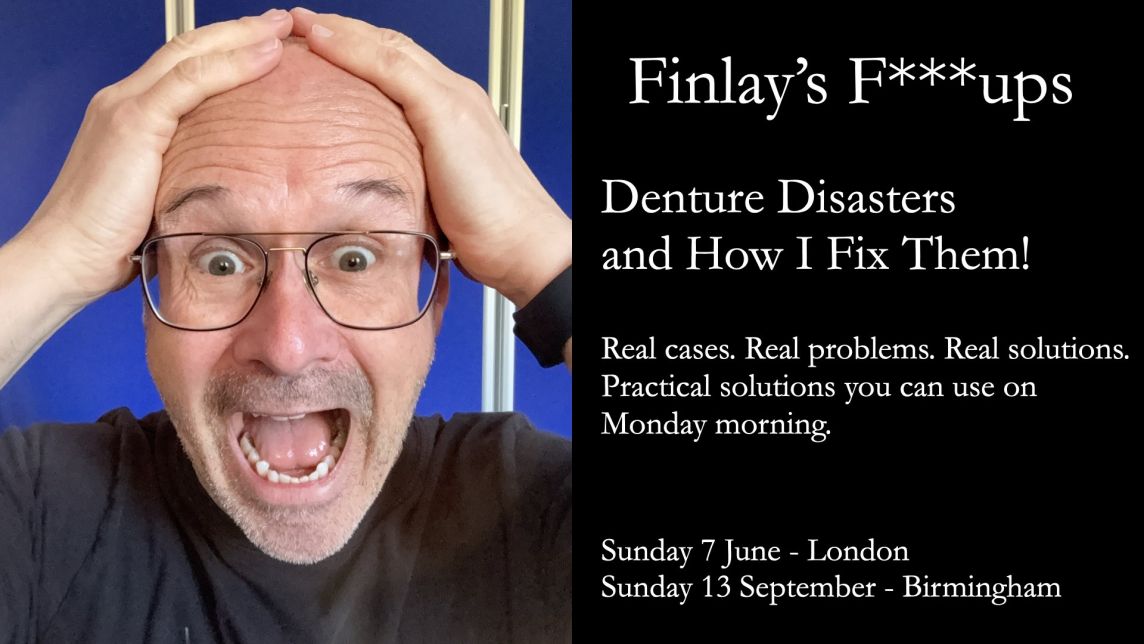
Finally, my Finlay’s F***ups — Denture Disasters and How I Fix Them seminar is coming to:
- Birmingham, Austin Court — Sunday 13 September 2026
Real cases.
Real problems.
Real-world solutions.
Practical ideas you can use on Monday morning.
Video about this course from me
£358.80 inc. VAT per person ( places still available)
Book here


Finlay's F***ups
What will you get from the day?
This is not a polished “perfect cases” lecture.
It’s a full day based around real-world removable prosthodontics — the difficult situations, the failures, the frustrations, the lessons learned, and the practical things that genuinely make a difference in clinic.
The aim is simple:
to help clinicians feel calmer, more confident, and more predictable with dentures.
Whether you are newly qualified, early in your career, or have been practising for decades, the principles discussed throughout the day are designed to help you avoid problems, improve outcomes, and enjoy removable prosthodontics more.
Throughout the day we will discuss:
• Loose lower complete dentures
• Difficult lower ridges and poor support tissues
• Partial dentures that do not work properly
• Implant overdenture complications
• Fractured overdentures, bars and attachments
• Failed implant cases and what to do next
• Bruxists and destructive patients
• Cases that became stressful or unpredictable
• Difficult patient management and communication
• Managing expectations from the beginning
• Recognising cases you may be better not treating
• How to avoid getting trapped in “remake cycles”
We will also cover:
• Better denture design principles
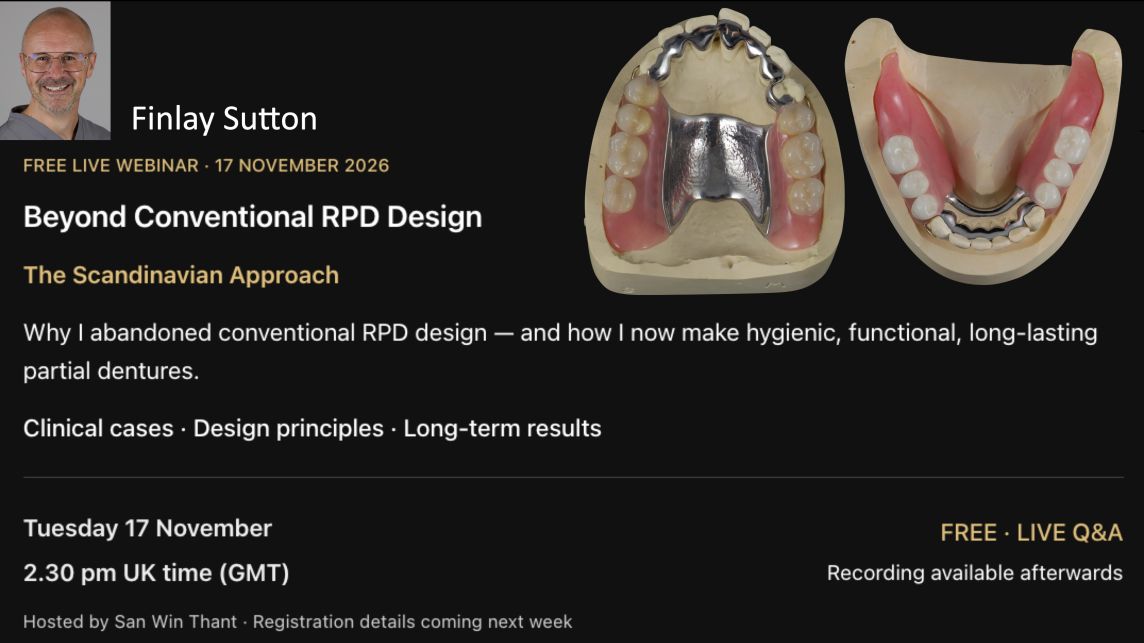
• Scandinavian removable partial denture design
• Tooth positioning and aesthetics
• How to improve impressions and bite records
• Communication with dental technicians
• Practical workflows that simplify treatment
• Ways to make dentures more natural-looking and biologically healthy
• How to create more predictable outcomes
• What actually matters most clinically — and what often does not
The day is built around real clinical cases with honest discussion about:
• what went wrong
• why it happened
• what I learned
• and what I would now do differently
This is not intended to be theoretical or overcomplicated.
The emphasis throughout is on practical solutions you can genuinely use on Monday morning.
My hope is that people leave the course:
• more confident
• less stressed
• better able to manage difficult situations
• and perhaps even enjoying dentures a little more than they did before.
Honestly, I think the course represents amazing value. Difficult denture cases and problem situations can cost clinicians many thousands of pounds — financially, emotionally, and in stress. If some of the ideas discussed throughout the day help people avoid even one major problem case in the future, the course will more than pay for itself.
London — Sunday 7 June 2026
Birmingham — Sunday 13 September 2026
Course fee: £358.80 inc. VAT per person
Real cases. Real problems. Real solutions.


In House Courses
These are small, personalised clinical courses that I run here in practice with Rowan working alongside me in the laboratory next door.
People travel to Garstang from all over the world to attend them, and we are very much set up for international delegates. Over the years we have welcomed clinicians and technicians from the USA, Canada, Australia, New Zealand, Scandinavia, Japan, India, China, Taiwan, Malaysia, Indonesia, South Africa, across Europe, and many other countries besides.
The courses are very different from large lecture-style meetings. The atmosphere is relaxed, friendly, practical, and highly interactive. We keep the delegate numbers deliberately low so that people can genuinely see what is happening, ask questions throughout the day, and properly understand each step of treatment.
The courses are built around real patients, real workflows, and real removable prosthodontics — not idealised textbook dentistry.
A huge amount of practical information is shared throughout the sessions:
• complete dentures
• removable partial dentures
• immediate dentures
• implant overdentures
• tooth positioning
• impression techniques
• occlusion
• Scandinavian partial denture design
• aesthetics
• laboratory communication
• workflow simplification
• patient management
• and the emotional side of denture treatment
The emphasis throughout is on practical solutions and understanding the thinking behind the treatment — not simply following recipes blindly.
One of the major advantages of the courses is that Rowan and I work side-by-side clinically and technically every day. Delegates therefore gain insight into both the clinical and laboratory aspects of treatment simultaneously, which many people find transformational in helping them understand removable prosthodontics properly.
People often comment that the courses completely change how they see dentures and removable prosthodontics. Many delegates tell me they leave feeling:
• more enthusiastic
• more confident
• less stressed
• and far clearer about how to approach difficult cases
The courses are expensive, and intentionally so. They reflect the enormous amount of experience, preparation, photography, documentation, teaching, clinical exposure, and honest sharing that goes into them. I hold absolutely nothing back — clinically or emotionally — because my genuine aim is to help people improve and avoid years of frustration and costly mistakes.
Honestly, I think these courses can significantly accelerate a clinician’s understanding of removable prosthodontics. Difficult denture cases can cost many thousands of pounds, huge amounts of stress, and endless emotional energy. If attendees apply even a portion of the ideas discussed throughout the courses, it can profoundly improve both patient outcomes and professional enjoyment.
My hope is simple:
to help clinicians and technicians make natural-looking, comfortable dentures that genuinely improve patients’ lives — whilst also helping people rediscover enthusiasm for removable prosthodontics.