Newsletter 89 - Simon
Hello everyone!
Well, it's all systems go again!
After a lovely, relaxing summer, September and October have been absolutely packed with clinical dentistry, teaching, mentoring, travelling and writing. And I have to say, I'm loving it!
Before I tell you about Simon's case, I've got something exciting coming up.
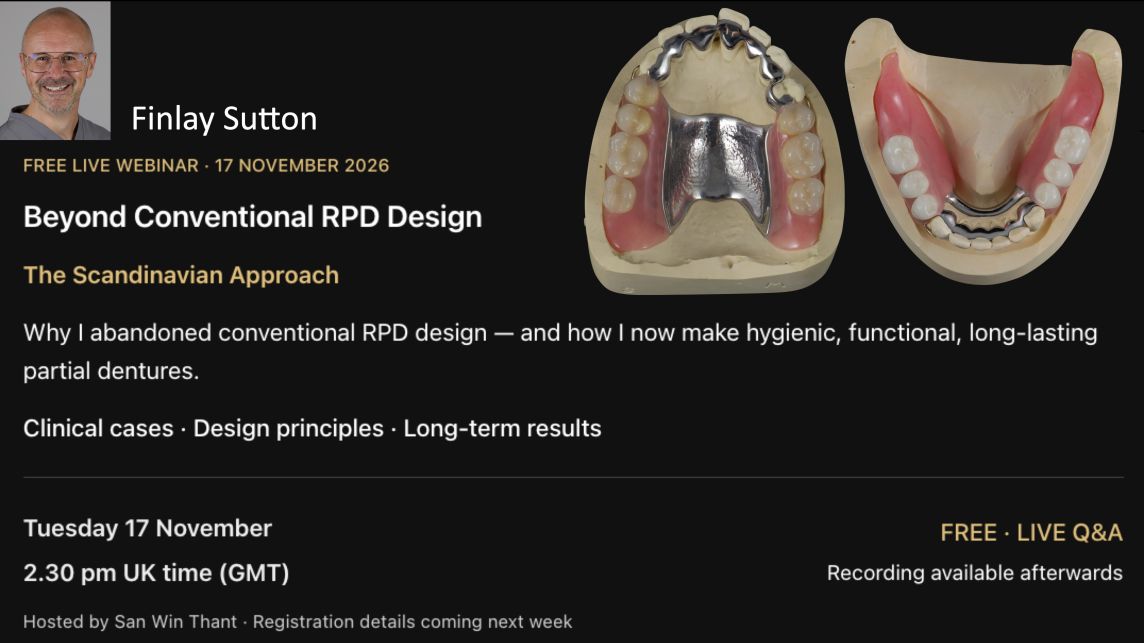
Free webinar – Beyond Conventional RPD Design
On Tuesday 17 November 2026 at 2.30 pm UK time (GMT), I'll be giving a free, one-hour webinar hosted by San Win Thant, who is based in Japan and runs an international removable prosthodontics education community.
Beyond Conventional RPD Design: The Scandinavian Approach to Hygienic, Functional and Long-Lasting Dentures
I'll be explaining why I've moved away from conventional RPD design towards the Scandinavian approach, which I now use exclusively.
I'll be showing clinical cases, long-term results, the reasoning behind my designs, and why I believe this approach offers such enormous advantages for our patients and their remaining teeth.
We'll also look at impressions, occlusion, hygienic design and how to plan dentures that can be modified if teeth are lost in the future.
There'll be time for questions, and the webinar will be recorded, so you'll be able to watch it afterwards too.
I'll be reposting this same newsletter on 18 October, this time with the free webinar registration link included, so you can book your place directly. Look out for it!
Now, onto Simon
I absolutely loved treating this lovely man. He was so interested, engaged and enthusiastic about everything we were doing. It makes such a difference when a patient really understands what we're trying to achieve.
This was a technically challenging Kennedy Class II Division 1 upper cobalt-chromium removable partial denture, made even more interesting by Simon's very high smile line.
In this newsletter, I've documented the treatment step by step, including the design, clinical stages, laboratory work and final result.
There are several details I particularly want to draw your attention to.
The metal backings
I absolutely love these.
The metal backings behind the upper anterior teeth are an incredibly important part of this design.
They help support and brace the denture, distribute occlusal forces, and protect the remaining natural teeth and their incisal edges from further damage.
They also provide the potential to add teeth to the denture in the future if further natural teeth are lost.
In this respect, the RPD provides some of the protective functions of an occlusal stabilisation splint, as well as replacing the missing teeth.
For me, these backings are one of the most valuable features of this Scandinavian approach.
The clasp assembly on 15
This is another detail I absolutely love.
On the upper right second premolar (15), which has a porcelain-fused-to-metal crown, I used an occlusal ring rest to provide support and stabilisation.
The ring rest itself isn't retentive. Retention comes from the separate wrought cobalt-chromium clasp, soldered to the framework using gold solder, which approaches occlusally and engages the mesiobuccal undercut.
Simon was very happy to accept the visible metal of the ring rest because he wanted maximum stability and security.
We could have used a simpler circumferential clasp, but I felt this arrangement would provide better bracing and support.
I love it when patients understand these compromises and actively participate in the decision-making.
We used just two retentive clasps in the entire denture.
The other was a wrought gold, gingivally approaching I-clasp on 13.
One of the great advantages of wrought clasps is how easily they can be adjusted with pliers if necessary. I find them far more forgiving than cast clasps. They're also wonderfully discreet, sitting high up the tooth, often hidden by the lip. So much more aesthetically pleasing than a bulky, unsightly occlusally approaching cast clasp!
And by carefully planning the path of insertion, we could also use the distal undercut of 22 to help with retention, avoiding the need for a visible clasp on this tooth.
It's these little design details that I find so satisfying.
What about the lower denture?
Simon had ten pairs of opposing biting surfaces.
We agreed to make the upper RPD first, and only consider a lower RPD if he subsequently felt he needed additional chewing support.
As it turned out, he didn't need a lower denture at all!
That's an important lesson in itself. We don't always need to replace every missing tooth.
And was everything perfect?
No!
I'd restored the incisal edge of 11, but it chipped again during treatment.
I recommended an occlusal stabilisation splint for night-time protection, but Simon was absolutely adamant that he didn't want one.
We discussed this, respected his decision, and managed the chipped edge conservatively.
The whitening worked beautifully, the denture fitted wonderfully, and Simon adapted extraordinarily well.
At his review appointment, the denture needed no adjustment.
But what mattered most was how he felt about himself.
He subsequently wrote to me:
"I went to a friend's party a few days ago, wearing my denture, and I felt so much happier with myself. Not having to disguise my gappy mouth, and smiling freely. It just lifted my whole evening!"
Isn't that wonderful?
This is why I love making dentures.
Teaching, mentoring and sharing ideas
A couple of weeks ago, I ran another two-day complete denture course here in Garstang. What a fantastic group!
We had delegates travelling from overseas, including Australia, and the enthusiasm was infectious.
One Australian colleague also spent two days mentoring with us beforehand: one day with me, looking at clinical work and how I've developed my referral practice, and one day with Rowan, concentrating on technical procedures and tooth arrangement.
He wants to develop something similar in Australia.
I find this incredibly rewarding. Being able to share what I've learnt, including the mistakes I've made along the way, and then seeing other people develop their own careers and practices is just wonderful.
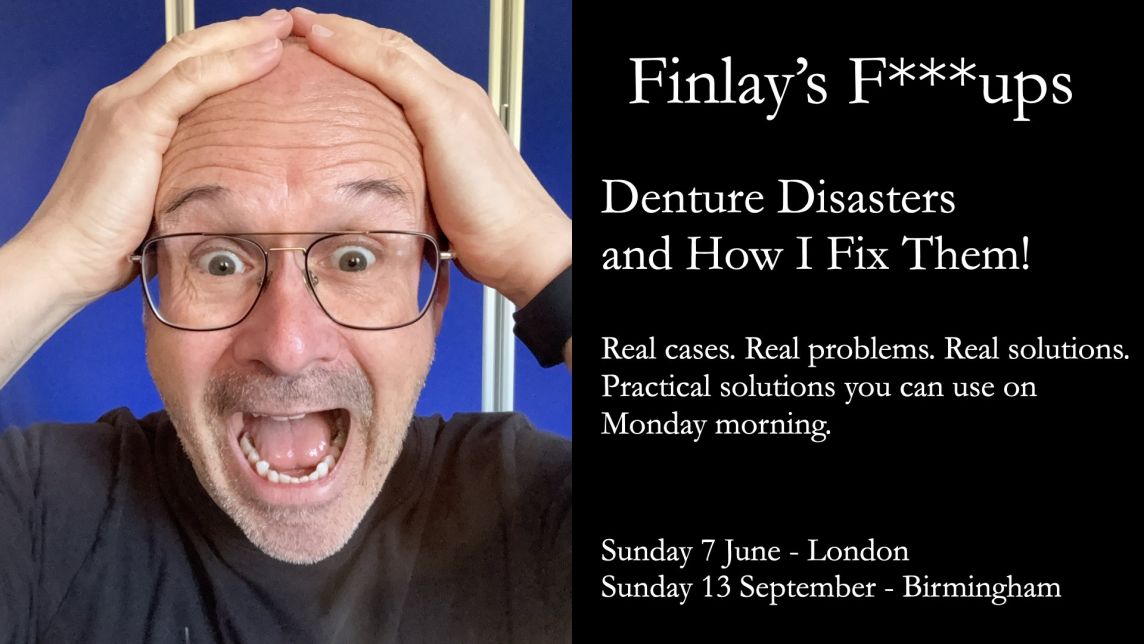
My Fin's Failures lecture in Birmingham was also tremendous fun.
I love these lectures because they're about the things that haven't gone to plan, what I've learnt from them, and how those experiences have changed the way I practise.
What's coming up?
This Thursday and Friday, 15–16 October, I'm running my two-day RPD course in Garstang.
I'm really looking forward to it, and there are still a few places available if anyone fancies joining us at short notice!
Clinical courses
Then, next week, I'm off to the USA W(inston-Salem, North Carolina) to teach for the Seattle Study Club.
I'll be spending a morning discussing all aspects of removable prosthodontics, and I'll also be doing some individual mentoring with an American colleague.
I'm particularly looking forward to catching up with my good friend and fellow dentist Ben Johnson over dinner.
It's going to be a fantastic trip.
Later in November, there's the Besford Study Club, where we'll be exploring digital workflows. It's such a wonderful group of enthusiastic, thoughtful clinicians and technicians, and I always come away with new ideas.
Exciting developments in Scandinavian RPD design
Behind the scenes, Rowan and I are working on something really exciting!
We're developing ways to make our Scandinavian RPD framework designs available digitally, making it much easier for clinicians and technicians around the world to access and use this approach.
It's still early days, but I'm incredibly excited about the possibilities.
Watch this space!
And outside dentistry?
Life is really good.
I'm now treating patients clinically on Mondays, which are wonderfully busy days, and spending the rest of my working week teaching, mentoring, writing and developing new ideas.
I'm enjoying the clinical work as much as ever, but I particularly love seeing other dentists and technicians flourish.
And I've been playing plenty of golf!
Wednesday is my golf day, and I've managed to get my handicap down from 21 to 11.8 over the past year.
I've been loving playing in competitions at Lancaster Golf Club. It's such a lovely contrast to dentistry, and I'm having enormous fun.
So, all in all, life is busy, sometimes challenging, but incredibly rewarding.
I feel very lucky to be doing what I love.
Thank you, as always, for following my work, reading these newsletters and sharing my enthusiasm for removable prosthodontics.
I hope you enjoy Simon's case as much as I enjoyed treating him.
Warmest wishes,
Fin
-------------------------------------------------------------------
Want to make better dentures?
Removable Partial Dentures — 2 days
My two-day RPD course is all about designing simpler, kinder and more effective partial dentures. We cover everything from assessment and design through to impressions, support, clasping, occlusion and working brilliantly with your technician.
Complete Dentures — 2 days
Come and spend two days with Rowan and me making complete dentures on a real patient, from start to finish. You’ll see every clinical and technical stage, understand why we do it, and learn a predictable approach you can take straight back into practice.
Implant Overdentures — 2 days
A practical approach to planning and making implant-retained overdentures, bringing the surgical, restorative and technical elements together.
Immediate Dentures — 1 day
Planning, impressions, tooth positioning, extractions, fitting and aftercare — making the transition from natural teeth to dentures as predictable as possible.
All Dentures Refresher Day — 1 day
Been on my Complete Denture course before? Come back for a concentrated day to refresh, refine and build on what you learnt.
Great dentures. Small groups. Loads of practical dentistry. And plenty of fun.


In House Courses
These are small, personalised clinical courses that I run here in practice with Rowan working alongside me in the laboratory next door.
People travel to Garstang from all over the world to attend them, and we are very much set up for international delegates. Over the years we have welcomed clinicians and technicians from the USA, Canada, Australia, New Zealand, Scandinavia, Japan, India, China, Taiwan, Malaysia, Indonesia, South Africa, across Europe, and many other countries besides.
The courses are very different from large lecture-style meetings. The atmosphere is relaxed, friendly, practical, and highly interactive. We keep the delegate numbers deliberately low so that people can genuinely see what is happening, ask questions throughout the day, and properly understand each step of treatment.
The courses are built around real patients, real workflows, and real removable prosthodontics — not idealised textbook dentistry.
A huge amount of practical information is shared throughout the sessions:
• complete dentures
• removable partial dentures
• immediate dentures
• implant overdentures
• tooth positioning
• impression techniques
• occlusion
• Scandinavian partial denture design
• aesthetics
• laboratory communication
• workflow simplification
• patient management
• and the emotional side of denture treatment
The emphasis throughout is on practical solutions and understanding the thinking behind the treatment — not simply following recipes blindly.
One of the major advantages of the courses is that Rowan and I work side-by-side clinically and technically every day. Delegates therefore gain insight into both the clinical and laboratory aspects of treatment simultaneously, which many people find transformational in helping them understand removable prosthodontics properly.
People often comment that the courses completely change how they see dentures and removable prosthodontics. Many delegates tell me they leave feeling:
• more enthusiastic
• more confident
• less stressed
• and far clearer about how to approach difficult cases
The courses are expensive, and intentionally so. They reflect the enormous amount of experience, preparation, photography, documentation, teaching, clinical exposure, and honest sharing that goes into them. I hold absolutely nothing back — clinically or emotionally — because my genuine aim is to help people improve and avoid years of frustration and costly mistakes.
Honestly, I think these courses can significantly accelerate a clinician’s understanding of removable prosthodontics. Difficult denture cases can cost many thousands of pounds, huge amounts of stress, and endless emotional energy. If attendees apply even a portion of the ideas discussed throughout the courses, it can profoundly improve both patient outcomes and professional enjoyment.
My hope is simple:
to help clinicians and technicians make natural-looking, comfortable dentures that genuinely improve patients’ lives — whilst also helping people rediscover enthusiasm for removable prosthodontics.